February Studio Blog
February Studio notes - What Rises From Beneath
There are moments in the studio when the future of a painting reveals itself in brief, shimmering glimpses as if something beneath the surface stirs and calls upward. These flashes arrive quietly, like light catching under water, and they remind me that the canvas is never just a surface. It is a threshold.
Sometimes a gesture, a colour, or a fragment of texture feels as though it has risen from somewhere deeper than intention. It speaks of a different kind of freedom a confidence that doesn’t come from technique but from allowing the subconscious, or the soul, to move ahead of the mind. In those moments, I feel less like I am making the painting and more like I am listening to it.
There is a power in that surrender. A sense that if I leave enough space in the brushwork, in the silence between decisions something larger than me can come through. Call it intuition, call it the unconscious, call it God; whatever name it takes, it feels like a presence that wants to be given room.
February will be a month of trusting those small emergences. Letting the painting show me its own direction. Allowing the hidden to rise. Then recognising that the most honest work often comes from the places we do not fully understand, but are willing to follow.
February Studio Notes - On Painting Without a Picture in My Mind
Lately I’ve been noticing something shifting in the studio. For years, I relied on a kind of internal cinema a clear image of what the painting should look like before I ever touched the canvas. That used to be enough. Capture the light, render the form, make it almost photographic. There was a satisfaction in that precision, in getting the world down exactly as it appeared.
But now that clarity has dissolved. I don’t have those internal pictures anymore, not in the way I used to. And instead of panicking about it though I’ve tried that too I’m beginning to understand that this absence is its own kind of invitation.
Without a fixed image to chase, I have to find other ways of sparking the work into life. I have to listen differently. Pay attention to the small impulses, the fleeting sensations, the half‑formed gestures that rise and disappear before I can name them. These glimpses aren’t full visions; they’re more like brief openings, little doorways into something I don’t yet understand.
And strangely, they’re leading me toward a deeper freedom.
I want the paintings to feel like mine not because they resemble a photograph I once saw in my head, but because they carry a voice that’s recognisably my own. I want to be able to paint anything mountain, sea, figure, abstraction and have it still feel like it belongs to the same inner landscape. That’s the direction I sense myself moving toward, even if I can only see it in fragments.
The truth is, I won’t find out what this new voice looks like by thinking about it. I’ll only find it by painting. By turning up, again and again, and letting the work reveal itself in real time. The glimpses are enough to keep me walking. The rest will come through the doing.
February Studio Notes - On Beginning With a Background
Another small realisation arrived in the studio this week, almost quietly. Without a fixed image in my mind to aim toward, I’ve been experimenting with different ways of beginning ways of stepping into a painting without knowing where it wants to go.
What’s emerging is a kind of freedom in starting from the background rather than the subject. Laying down broad fields of colour, letting them breathe, and then slowly introducing mixes of blues and browns, watching how they settle into one another. There’s something grounding about it like preparing the weather before deciding on the landscape.
And then there’s the unexpected magic of adding just one more colour, barely 5% of the mix. The smallest shift. A whisper of something else. It creates the illusion of a whole palette at work, even though the painting is still anchored in a very limited range. It’s a reminder that complexity doesn’t always come from quantity; sometimes it comes from subtlety, from restraint, from the courage to let small decisions carry weight.
This approach feels like another doorway into the voice I’m trying to uncover a way of building depth without relying on a pre‑existing picture in my mind. It’s a method that invites surprise, that allows the painting to reveal itself layer by layer rather than being forced into a predetermined shape.
February Studio Notes — On Vastness, Exhaustion, and Beginning Again
This month I’ve been making some of the biggest paintings I’ve ever attempted huge fields of ocean and horizon, nothing but sea, sky, and that endless line where the two collapse into one another. Standing in front of them feels a little like standing at the water’s edge itself: no buildings, no people, no narrative, no buyer in mind. Just nature. Just scale. Just the quiet shock of being small beside something vast.
These paintings have no real ending. They could be changed forever. The abstract patterns of the waves keep shifting under my hands, forming and dissolving, cresting and collapsing. Every time I think I’ve reached a finish point, the painting asks for something else. It takes so much from me, physically, emotionally, that I’m often left empty after a day in the studio. There’s a strange kind of loneliness in chasing an unknown destination, trying to understand what it is I’m reaching for by the act of painting itself.
It’s exhausting. But it’s also necessary.
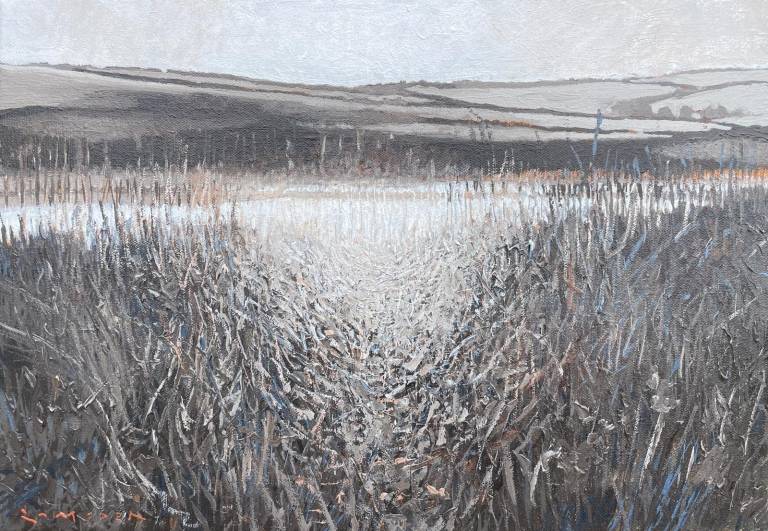
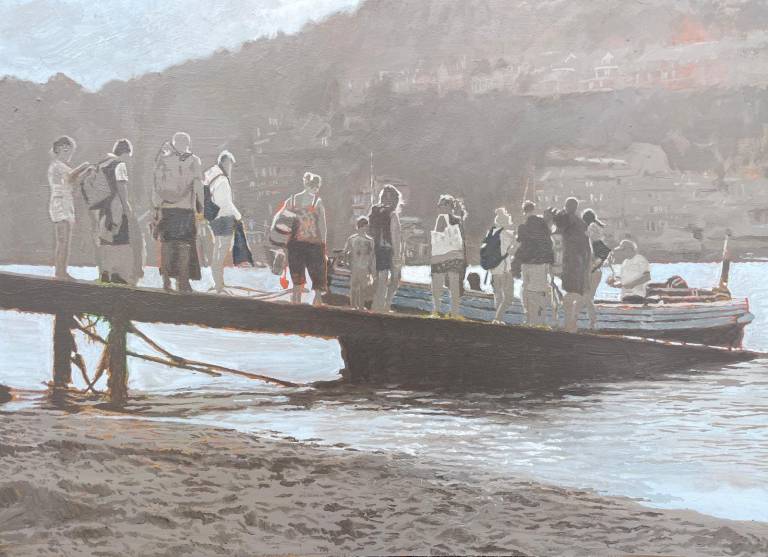
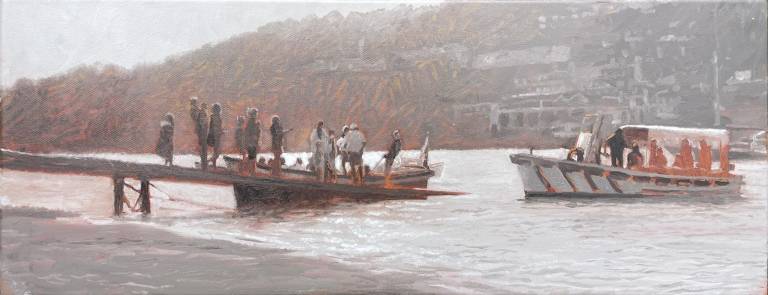
And on the other side of that exhaustion, I can feel a new direction opening. I’m beginning to look forward to creating a series of works rooted in a kind of custom history a quieter, more distilled palette, returning to my monochrome language but carrying something from the ocean paintings with me. The ultramarine I’ve been using at sea has found its way into the browns, giving me a warm–cool tension I’ve never quite had before. Even in limited colour, there’s light now. There’s movement.
Before I commit to the larger canvases, I’m going back to something I’ve always done but never fully valued: quick studies in the sketchbook. Small, instinctive paintings based on the photographic imagery I’m considering. Not finished pieces, more like meditations. A way of sitting with the possibility of a painting before I make it real. These little studies feel like a kind of freedom, a space to explore without pressure, to test the atmosphere of an idea before it becomes something heavier.
It means a longer process at the beginning, but I think the work will be stronger for it. More intentional. More alive.
February has been a month of vastness and depletion, but also of quiet beginnings — the sense that something new is forming just beneath the surface, waiting for me to follow it.
February Studio Notes On Seeing, and Seeing Through Ourselves
There’s a line that’s been circling my mind this month: We don’t see things as they are, we see things as we are.It feels especially true in the studio right now.
I keep realising that every painting I make whether it’s a vast ocean horizon or a quiet monochrome study is less about the subject in front of me and more about the state I’m in while making it. The sea isn’t just the sea. The horizon isn’t just a line. They become mirrors, reflecting back whatever I’m carrying that day: exhaustion, curiosity, longing, restlessness, the desire for clarity, the need for escape.
When I stand in front of those huge ocean canvases, I’m not just painting water and sky. I’m painting the part of me that wants to disappear into something bigger. The part that wants to be emptied out. The part that’s searching for a finish point that doesn’t really exist. These works could go on forever shifting, dissolving, reforming because the thing I’m chasing in them is something internal, not external. And that’s why they take so much from me. They demand honesty. They demand presence. They demand that I meet myself in the act of making.
But that same line we see things as we are is also what’s guiding me into the next phase.
As I move toward the custom‑history pieces, the monochrome palette, the ultramarine slipping into the browns, I’m noticing a different kind of seeing. A quieter one. Less about vastness and overwhelm, more about precision and intention. I’m beginning with small sketchbook studies again quick, instinctive paintings of the imagery I’m considering. They’re not finished works; they’re meditations. A way of sitting with possibility without forcing it into form too soon.
In those small studies, I can feel myself seeing differently. Not chasing an ending, but exploring a beginning. Not trying to capture the world as it is, but understanding how I’m meeting it what colours I’m drawn to, what shapes feel alive, what stories want to surface.
Maybe that’s the real work of this month: learning to recognise that every painting is filtered through who I am in that moment. And instead of resisting that, I’m letting it guide me. Letting it shape the palette, the scale, the rhythm of the brush. Letting it be part of the process rather than something to overcome.
February has been a reminder that the canvas doesn’t just show what I see it shows how I see. And that, more than anything, is what keeps the work alive.
February Studio Notes — A Clearing
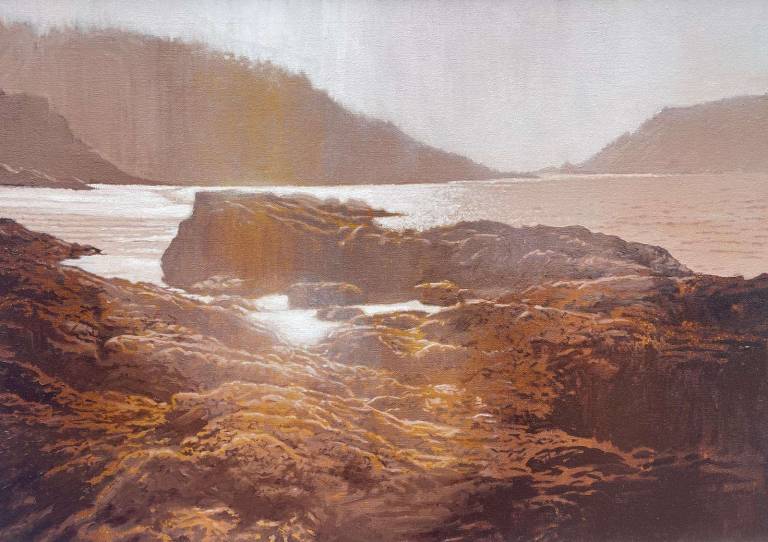
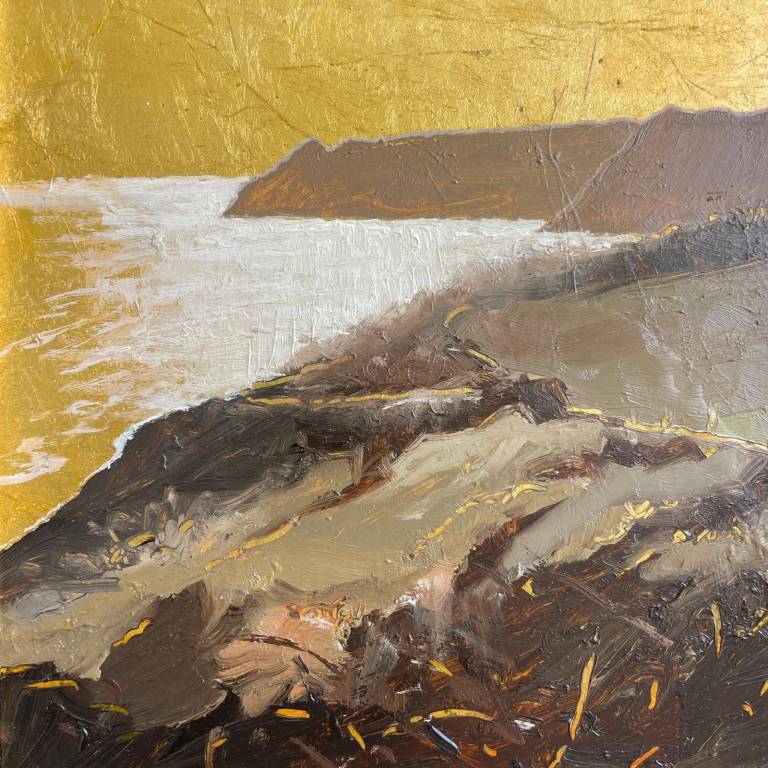
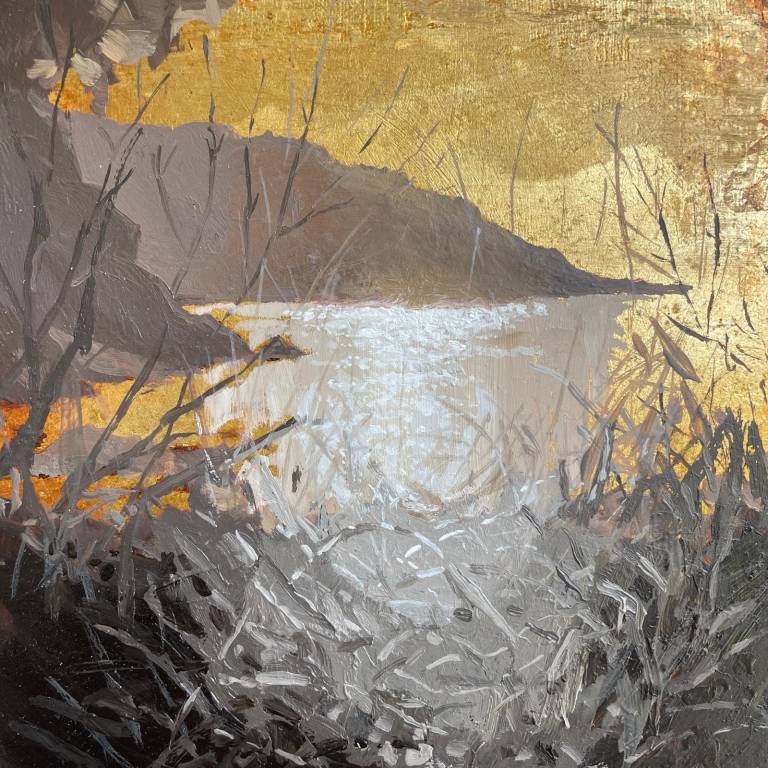
The big ocean painting left the studio this week for the London Art Fair, and its absence has created a surprising quiet. With that work gone, I feel free to turn fully toward the Coastlines and estuaries exhibition a project shaped by a year of walking the edges of Cornwall and Devon, noticing how the land holds its own stories.
The drawings I’m working on now come directly from those walks: cliff lines, tidal marks, small human traces folded into the landscape. They feel like beginnings grounded, local, and connected to the places that have been shaping me quietly over the past year.
In the studio, I’ve been experimenting with alcohol markers and bleed‑proof paper, enjoying their immediacy and the way they force clarity. But alongside that, I’ve found myself returning to familiar habits: leaving areas blank so the underpainting can breathe through, letting early marks remain visible, allowing the painting’s history to stay present on the surface.
These things used to feel instinctive, almost accidental. Now they feel like part of a rhythm patterns that return because they belong to the way I work. February feels like a threshold: one painting leaving, a new series beginning, and the recognition that the process repeats not out of habit, but because it’s true.
February Studio Notes Listening Backwards Through Time
I’ve been walking today, answering questions for the Drift article, and somewhere between the river path and the quiet of the woods I realised how closely my current work still echoes what I was doing at university. Back then, I wasn’t painting landscapes I was recording them. Hours of sound gathered from woodlands, moorlands, quarries, churches, stone circles, sacred spaces. I was trying to capture the feeling of a place without relying on words or images, to translate the world into something deeper and less literal.
Those recordings were always slowed down in the end. Stretched until the recognisable sounds dissolved and a low, vibrating drone emerged a kind of hidden frequency beneath the audible world. Each landscape revealed its own resonance: subtle differences, quiet pulses, the sense that there are layers of reality our senses only brush the edges of.
As I walked today, it struck me how much that instinct still shapes my painting. I’m still trying to listen beneath the surface. The estuaries, coastlines, and histories I’m working on now aren’t about describing what a place looks like. They’re about tuning into the deeper register, the atmosphere, the season, the emotional weather, the quiet transitions that sit underneath the visible world.
The colours I choose, the blank spaces I leave, the marks I allow to remain from the first layer they’re all part of that same search. A way of letting the painting hold the resonance of a place rather than its appearance. A way of listening through paint the way I once listened through sound.
February ends with that reminder the work changes, but the impulse stays the same. I’m still trying to catch the hidden frequencies of the world, the ones that sit just beneath what we can see or hear.