April Studio Blog
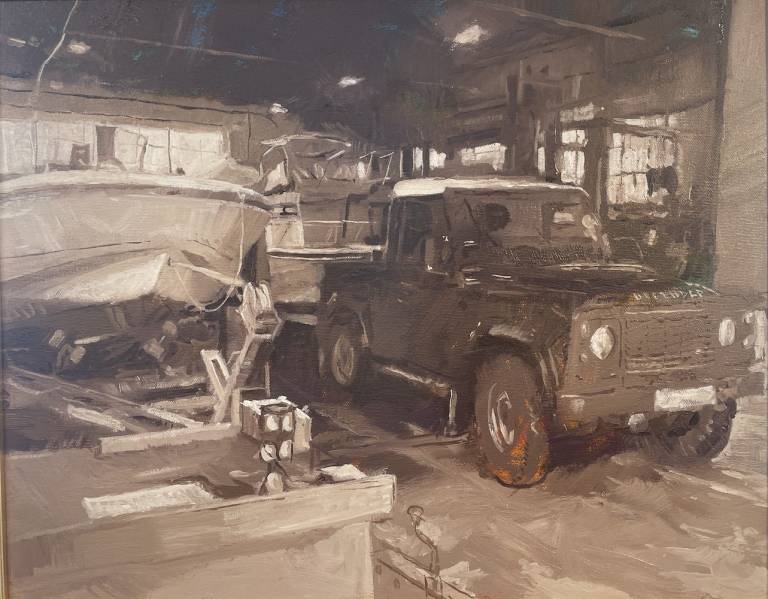
April studio blog
The Unwritten World
The brush finds what the tongue cannot,
A syntax made of salt;
The heavy light, the anchor’s knot,
The quiet architecture of time.
It is the edge where headlands blur,
The almost-there,
Where words are ghosts that fail to stir,
And only shadows have their say.
Don't speak the sea, or name the tide,
Just leave the scaffolding in view;
For in that space we step aside,
The world begins to write,
Line and form made of syntax,
Time of quiet architecture with heavy fallen light,
So now speak the sea and name the tide,
Dissolve that scaffolding of sorry repose,
Form a view for a space set aside.
April Studio Blog - The Value of Emotion
This month I’ve been thinking about the emotional undercurrent in painting, that quiet force beneath the surface that gives an image its pulse. People often assume colour is the primary carrier of emotion, but for me it has always been value. The subtle shifts between light and dark, the way a tone softens or sharpens, the quiet persuasion of contrast, this is where feeling lives.
Value is unconditional. It doesn’t shout. It doesn’t decorate. It simply shapes the emotional truth of a moment. When I manipulate value, even slightly, the entire atmosphere tilts. A softened shadow can feel like a memory returning; a sharpened highlight can feel like clarity breaking through.
What fascinates me most is the lost edge ,that place where light becomes so intense that form dissolves. The boundary disappears, slipping into softness, like the blur at the edge of a recollection. These vanishing edges feel closest to lived experience: the way moments fade at the periphery, the way presence is felt more than seen.
In the studio this April, I’m chasing that sensation, the emotional weight of value, the honesty of light, and the fragile edges where memory and perception meet.
April Studio blog - On Colour’s Subjectivity and Value’s Certainty
Lately I’ve been returning to a simple truth in my studio colour is subjective, but value is the opposite. Colour bends to perception, it shifts with mood, memory, and the light of the moment. Two people can look at the same scene and feel entirely different temperatures, harmonies, or emotional tones. Colour is personal, interpretive, fluid.
But value doesn’t negotiate.
Value is structure, weight, and emotional gravity. It’s the anchor beneath the surface, the thing that holds the painting together long before colour enters the conversation. When I’m working, it’s the value pattern, not the palette, that determines whether a painting breathes or collapses.
What fascinates me is how value carries emotion without needing to declare itself. A darkened plane can feel like a held breath; a softened mid‑tone can feel like a memory loosening its edges. And when light becomes so intense that it erases the boundary of a form, that lost edge becomes a kind of truth, a reminder of how we actually experience the world: not in perfect outlines, but in fleeting impressions.
Colour may seduce, but value tells the story.
April Studio blog — When Colour Becomes a Signal
Lately I’ve been thinking about how emotion enters a painting. I’ve always trusted value to carry the deepest weight, the quiet architecture of feeling that sits beneath everything. But I’m beginning to see how a slight inclusion of colour might not compete with value at all. Instead, it can help the values speak louder. I just want it to be so subtle it works on the subconscious level.
What interests me is the idea of colour used sparingly,almost ceremonially. Not as a wash across the whole surface, but as something that lives at the edges, a faint ring of remembering, a halo of atmosphere that frames the monochrome world inside it. A whisper rather than a declaration. A rising undercurrent gentle felt not seen.
Or perhaps colour appears only in small, deliberate moments: a signal light, a blinking directional marker, a fragment of intensity that punctuates the grayscale. These tiny interruptions of hue become emotional cues not overwhelming the values, but sharpening their intention.
By keeping the core of the painting rooted in monochrome, the values rise up with greater clarity. And the selective colour becomes a kind of experiment, a way of testing how memory, sensation, and presence can coexist on the same surface.
It feels like a new language forming one where value speaks the truth, and colour quietly underlines it.
April Studio Blog — Where Colour Circles the Light
Today a new idea has been forming in the studio, the thought of letting colour live on the outside, while the focal point remains monochromatic, held entirely in value. It feels like a reversal of expectation: the world around the subject shimmering with hue, while the centre stays quiet, distilled, almost devotional.
What draws me in is how the light itself becomes the bridge. When the light is so intense that it burns away the edges, the boundary between colour and monochrome dissolves. The form softens, the perimeter blurs, and the painting begins to feel like a memory returning not sharply, but as a sensation.
Around that dissolving centre, I imagine a halo of colour, a kind of dancing scintillation like the patterns you see when you press your eyes closed. Fleeting, electric, emotional. Colour not as description, but as pulse. As breath. As the outer weather of a moment.
Inside that ring, the monochrome values can rise with even greater clarity, the emotional architecture revealed, unembellished. Outside it, colour becomes the echo, the atmosphere, the vibration of feeling.
It’s a way of painting presence: the world shimmering at the edges, and the truth held in the light.
April Studio Blog - Morning Light, Learning to See Again
For most of my life, the inside of my mind has been a quiet, imageless place. Aphantasia has always been the default, thoughts without pictures, memories without scenes, imagination without form. I knew ideas, but I didn’t see them. Not the way other people described.
But something has shifted recently. With the reality of knowing about this not being the case for many people I have set out to increase or discover my inner visual world. At the moment It’s small, fragile, and fleeting, it only happens in the morning or evening seconds before sleep.
There’s a window of time, maybe ten minutes after waking, where the boundary between sleep and consciousness is still soft. In that space, if I breathe slowly through and let myself settle, something begins to happen. Shapes. Light. A kind of crystal shimmer that isn’t quite an image but isn’t nothing either.
It’s like my mind is learning to project for the first time.
At first, the only thing I could hold onto was a strong emotional anchor, an image charged enough to cut through the fog. That emotional spark seemed to unlock something. From there, the visuals would shift on their own, morphing into objects I didn’t choose: a childhood glass pint mug spinning in space, then a ceramic blue mug of my grandmothers I still own, a fragment of memories deep in the past.
I couldn’t steer any of it.
I still can’t, not really.
But I can stay with it for longer now.
The morning has become a kind of training ground. I lie there, breathing, trying to not try to much to get the images rise again. I don’t force anything. I just watch. And each day, the window stays open a little longer. There is now the re occurrence of blue light light that feels less like a dream and more like something I’m actually visualised. It is changing the way I think about my art. My paintings have always come from observation, memory, and atmosphere, but never from internal imagery. Now, for the first time, I’m beginning to understand what it means to “see” something before it exists. Not clearly, not controllably, but enough to feel the potential. The images I have so far conjured in this space. Have you ever had a strong emotional memory attached to them or have been geometric shapes but disability to let them become feels like very first genuine official creations from my mind.
Maybe this is what early imagination feels like.
Maybe this is the beginning of a new way of working.
Or maybe it’s simply a reminder that the mind is not fixed or it’s plastic but responsive, capable of surprising us even after decades of silence.
Whatever it is, I’m following it.
Each morning, before the day hardens, I lie there and try to see in a soft space projected from myself.
something is waking up.
April Studio Blog - On Memory, Place, and the Things We Forget
I was talking with a poet friend recently, the kind of conversation that drifts the way tidewater does, slow, reflective, carrying, raising things to the surface. We found ourselves circling around memory, and how strange it is that we can live whole chapters of our lives and yet struggle to recall the simplest details. Not the big moments, but the quiet architecture around them: the layout of a house we lived in for years, the shape of a hallway, the way the light fell across a kitchen floor.
It’s odd, isn’t it? We can remember the emotions of a time the warmth, the stress, the tenderness but the physical space that held those emotions slips away. Rooms blur. Corners vanish. Even homes we owned become vague outlines, like half‑erased drawings.
But then something happens.
A photograph appears a snapshot from that period and suddenly the mind begins to reassemble the world. The image becomes a touchstone, a small anchor dropped into the sea of memory. Details rush back: the colour of a wall, the location of a child’s room, the sound the door made when it closed. The photograph doesn’t just show us what was there; it unlocks what was stored but inaccessible.
And this is where the conversation took a turn that stayed with me.
My friend told me about someone who had seen one of my paintings a piece tied to a specific place and how it brought back memories of their children at that very spot. Not because the painting showed the children, but because the place did. The landscape acted as a key, opening a door they didn’t realise had been closed.
It made me think about how we remember our children. Not as a continuous, perfect reel, but as flashes a laugh, a gesture, a moment of sunlight on their hair. We don’t remember them as bodies moving through time, but as impressions. And yet, place can restore what time erodes. A shoreline, a footpath, a bend in the path, these things hold memory in a way the mind sometimes can’t.
Maybe that’s why we return to certain locations again and again.
Maybe that’s why I paint them.
A painting, like a photograph, can become a touchstone not a record of what happened, but a way back into the emotional landscape of a life. A way to recall the things we thought we’d lost: the small hands, the early mornings, the summers that felt endless.
Place remembers, even when we don’t.
And sometimes, all we need is a glimpse of it, in a photo, in a painting for the rest of the story to return.
April Studio Blog - On Algorithms and the Undercurrent
This month I’ve been thinking about algorithms not the technical side, but the way they’ve slipped beneath the surface of daily life. A couple of seconds’ pause over a video is enough to reset an algorithm now. A tiny hesitation becomes a signal. A flicker of interest becomes a prediction. And even when we’re away from our phones, that logic follows us.
We’ve started to move through the world as if everything is a feed: scanning quickly, filtering instinctively, expecting instant clarity. The rhythm of the algorithm has become the rhythm of attention. It shapes how people look, how they choose, how they drift past things without really seeing them.
And yet, this is exactly the territory that draws me in as an artist.
Algorithms feel like a new kind of tide invisible systems running underneath the visible world. They’re not dramatic, but they’re powerful. They shift behaviour quietly, subtly, almost imperceptibly. And that sense of something moving beneath the surface is the same energy that excites me in the studio.
It’s there in the estuaries I keep returning to.
It’s there in the colour fields that seem to breathe from underneath.
It’s there in the slow build of a painting, where the first marks sit like buried signals waiting to rise.
I’m realising that part of my work is a response to this algorithmic pace a counter‑movement. A slowing. A deepening. A way of reclaiming the pause that the world keeps trying to erase. Because if algorithms train us to skim, art invites us to linger. If algorithms predict, art unsettles. If algorithms flatten, art opens.
Maybe that’s why I’m drawn to the undercurrent: because it mirrors the hidden systems shaping our lives, but it does so in a human, atmospheric, empathetic way. It reminds me that not everything unseen is mechanical. Some things are emotional. Some things are ancient. Some things are simply waiting.
And perhaps that’s the quiet role of the artist now,
to stay awake to the things rising from underneath,
to feel what others rush past,
and to make work that restores the depth algorithms
April Studio Notes — On Slowing the Brush
This month has been about slowing everything down, not in a grand, philosophical way, but in the small, almost invisible moments where a painting actually changes. I’ve been paying closer attention to the instant the brush touches the surface, to the way the paint leaves the bristles, to the quiet decisions that happen before the next movement is made.
What I’m noticing is this. when I slow the brush, the painting slows with it. The mark becomes less of an action and more of a conversation. Instead of placing a stroke and immediately moving on, I’m letting the brush stay on the canvas a fraction longer long enough to feel the drag, the weight, the slight shift in tone as the pigment settles. That extra second changes everything. It alters the rhythm. It alters the intention. It alters me.
There’s a different kind of attention required here. A more deliberate thought process. Not cautious, not hesitant, just present. The kind of presence that lets the painting tell you what it needs rather than the other way around. I’m realising how often speed disguises itself as confidence, when in fact the quieter, slower movements carry far more clarity.
Watching how the paint comes off the brush has become its own practice. Sometimes it releases in a clean, confident